Private & Sovereign AI:Why Enterprises Are Leaving Public Cloud LLMs
Strict data residency laws, IP leakage risks, and astronomical public token bills are driving a massive enterprise migration toward on-premise and private VPC open-weights models in 2026.
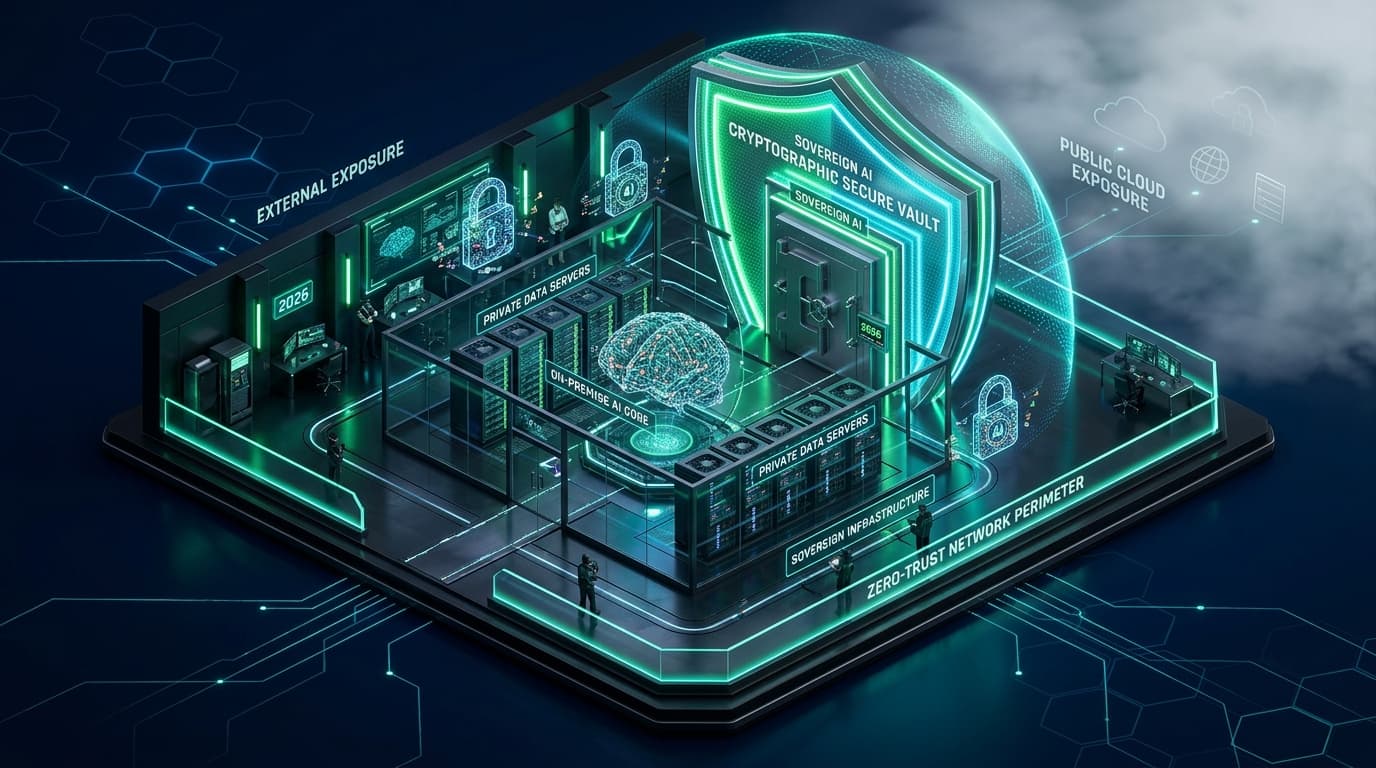
The Hidden Risks of Public Foundation Model APIs
When organizations feed internal financial ledgers, proprietary software source code, customer records, and confidential healthcare files to public cloud APIs, they surrender control over their most valuable business asset: proprietary intelligence.
In 2026, forward-thinking CTOs and enterprise architects are actively repatriating AI compute. Powered by high-performance open-weights models and ultra-efficient inference frameworks like vLLM, enterprises are deploying Sovereign AI—self-hosted models that operate entirely within their own private cloud VPC or local on-premise infrastructure with zero external egress.
Public Cloud LLM APIs vs. Private Sovereign AI
Evaluating the critical dimensions of cost, security, latency, and compliance for enterprise workloads:
| Dimension | Public Cloud APIs (OpenAI/Anthropic) | Private Sovereign AI (Self-Hosted) |
|---|---|---|
| Data Ownership & Residency | Processed on third-party multi-tenant cloud servers | 100% On-Premise or Private VPC within chosen jurisdiction |
| Training Data Leakage Risk | Risk of prompts being retained or audited by vendor | Mathematically Zero: Air-gapped, zero-retention pipelines |
| Inference Cost at Scale | Linear token-based pricing (Escalates aggressively) | Fixed hardware amortization (Decreases per token by 70-85%) |
| Latency & Throughput Guarantee | Subject to public cloud rate limits and outages | Dedicated local GPU clusters with deterministic sub-30ms TTFT |
| Regulatory Compliance | Complex cross-border compliance (EU AI Act, HIPAA) | Native adherence to local data protection laws & sovereignty |
| Customizability & Fine-Tuning | Restricted system prompts and limited API parameters | Unrestricted LoRA fine-tuning on proprietary enterprise weights |
The 4 Drivers of Enterprise Sovereign Computing
1. Data Geopatriation & Zero-Retention
National data privacy laws (EU AI Act, GDPR, and regional Data Protection Acts) increasingly mandate that citizen financial, medical, and identity data cannot cross borders. Sovereign AI ensures all vector embeddings and inference calculations never leave the physical jurisdiction of your enterprise.
2. Open-Weights Superiority at Fractional Cost
With breakthrough open-weights architectures (such as DeepSeek-R1, Llama 3.3 70B, and quantized Mistral models), private models match or surpass closed proprietary APIs on domain-specific enterprise tasks at 15% of the operational inference expenditure.
3. Total Intellectual Property Protection
Enterprises in fintech, healthcare, and engineering possess proprietary algorithms, client records, and legal briefs. Self-hosting models behind private corporate firewalls guarantees your core corporate intelligence is never ingested to train public foundation models.
4. Deterministic Reliability & SLA Independence
Public cloud AI endpoints suffer from periodic global outages, stealth model updates that break deterministic regex parsing, and strict rate limits. Sovereign private clusters deliver 99.99% uptime with complete model version freeze controls.
The SoftGen 5-Stage Sovereign AI Migration Roadmap
Transitioning enterprise intelligence from public endpoints into sovereign environments requires rigorous infrastructure planning:
Data Audit & Sovereignty Requirements Mapping
Identify sensitive data classifications, regulatory compliance obligations, and latency thresholds across internal departments.
Open-Weights Model Selection & Quantization
Benchmark task-specific open-weights models (DeepSeek-R1, Llama 3.3, Qwen 2.5) and apply AWQ 4-bit or 8-bit quantization for optimal GPU memory efficiency.
Private VPC / Bare-Metal Infrastructure Provisioning
Deploy hardened inference clusters utilizing vLLM, TensorRT-LLM, or Triton Inference Servers with automatic horizontal scaling and local pgvector clusters.
Domain LoRA Fine-Tuning & RAG Integration
Index proprietary enterprise knowledge repositories using private vector embeddings with zero external API calls.
Zero-Trust RBAC & Auditing Integration
Enforce strict employee permission gates, automated prompt sanitization, and immutable encrypted access logs.
How SoftGen Secures Enterprise AI Operations
SoftGen partners with enterprises across Sri Lanka, Southeast Asia, and global markets to deploy bespoke sovereign AI environments. We bridge the gap between deep machine learning infrastructure and business software execution:
Sovereign AI Deployment FAQs
Can open-source self-hosted models genuinely compete with proprietary models in 2026?
Yes. State-of-the-art open-weights models like DeepSeek-R1 and Llama 3.3 70B match or outperform closed commercial APIs across core enterprise domains including coding, financial analysis, document extraction, and reasoning, especially when fine-tuned on custom corporate data.
What hardware is required to host private enterprise AI?
Modern 4-bit and 8-bit quantization techniques allow high-throughput enterprise inference to run on cost-effective dedicated GPU instances (e.g., NVIDIA L4, A10G, or dual H100/A100 clusters for high-volume enterprise workloads), often costing less than monthly token bills from public cloud providers.
How does private AI maintain data compliance?
Because private AI operates entirely within your organization's private VPC (AWS, Azure, Google Cloud Private Cloud) or on-premise data center, no data leaves your security boundary, satisfying GDPR, HIPAA, ISO 27001, and regional data protection regulations out of the box.
How does SoftGen help organizations transition to Sovereign AI?
SoftGen designs, deploys, and manages private sovereign AI infrastructure for enterprises. We handle hardware sizing, vLLM cluster deployment, domain fine-tuning, private vector search integrations, and enterprise app connectivity with strict SLAs.
Secure Your Corporate Intelligence
Schedule a Sovereign AI Infrastructure Review
Learn how your enterprise can deploy high-speed private AI models on dedicated VPC or on-premise infrastructure while eliminating IP exposure and drastically lowering token costs.