How to Build anAI Assistant
A Complete Guide to Designing Intelligent AI Assistants That Drive Business Growth
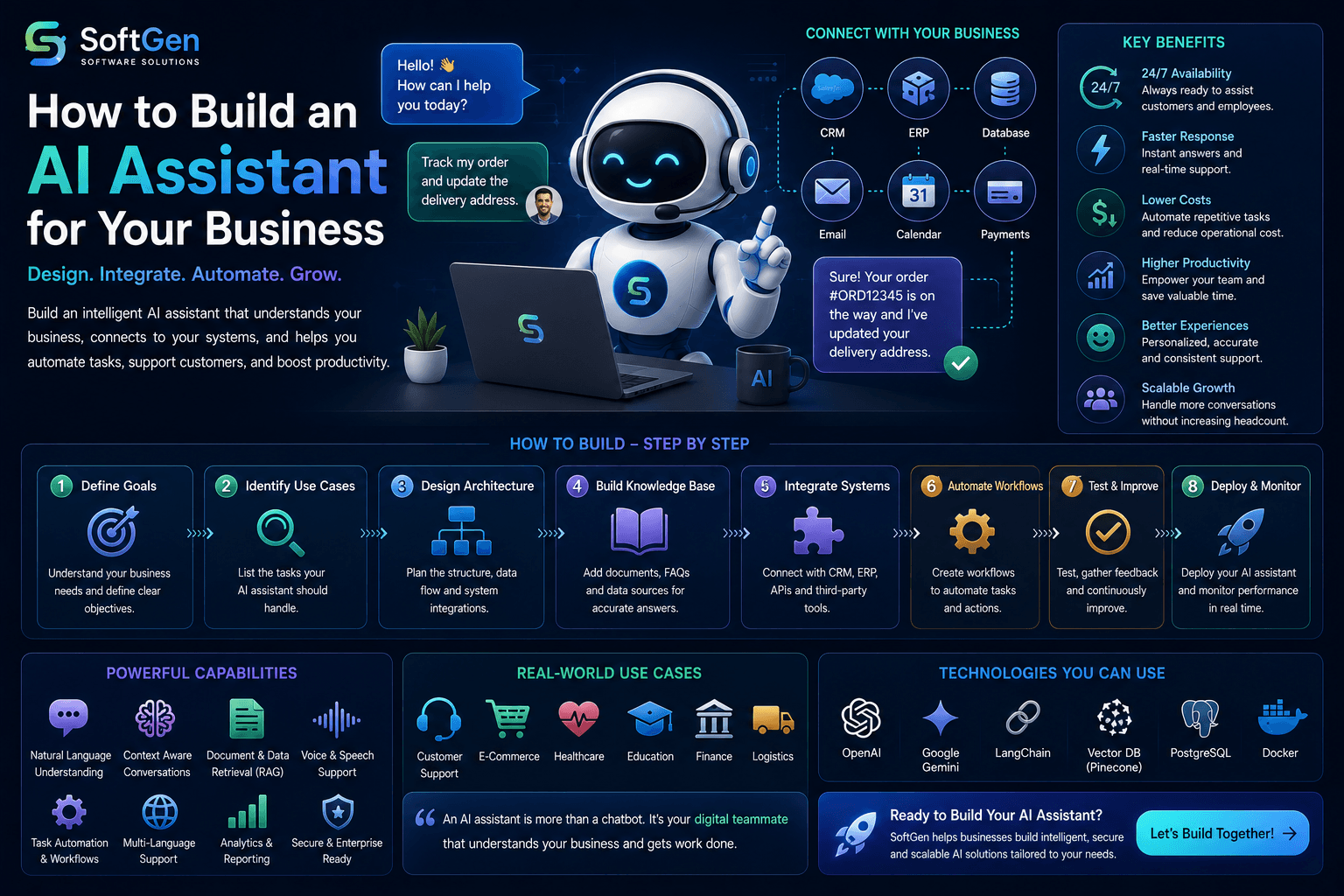
AI Assistants Are Transforming Business Operations
Artificial Intelligence has evolved far beyond simple chatbots.
Today AI assistants can answer customer questions, automate workflows, retrieve company knowledge, generate reports, schedule meetings, and integrate with business software.
From startups to large enterprises, organizations are investing in AI assistants to improve productivity, reduce operational costs, and deliver exceptional customer experiences.
However, building an AI assistant involves much more than connecting a language model to a website.
A successful AI assistant requires careful planning, the right architecture, secure integrations, and a clear understanding of your business processes.
In this guide, we will explore how businesses can design and build production-ready AI assistants.
What Is an AI Assistant?
An AI Assistant is an intelligent software system capable of understanding natural language, retrieving information, making decisions, and performing real-world tasks.
Unlike traditional chatbots, AI assistants can interact with multiple business systems while maintaining context throughout a conversation.
A modern AI assistant can:
Instead of simply responding to questions, AI assistants actively help users complete work.
Free AI Assistant Consultation
Ready to Build an AI Assistant for Your Business?
Our AI engineering team will analyze your requirements, design the right architecture, and recommend the best approach for building your AI assistant - completely free.
Step 1: Define Your Business Goals
Every successful AI project starts with identifying the problem you want to solve.
Clear goals help determine the scope and capabilities of your AI assistant.
Step 2: Identify Use Cases
Different industries require different AI capabilities.
- Answer FAQs
- Track orders
- Handle returns
- Create support tickets
- Appointment booking
- Patient FAQs
- Medical document search
- Prescription reminders
- Student support
- Course recommendations
- Exam information
- AI tutoring
- Shipment tracking
- Route updates
- Inventory inquiries
- Delivery notifications
- Invoice processing
- Expense reporting
- Financial summaries
- Compliance assistance
Step 3: Design the AI Architecture
A production-ready AI assistant consists of several components working together.
Rather than relying only on an LLM, enterprise AI assistants integrate multiple services to provide accurate and actionable responses.
Step 4: Choose the Right AI Model
Selecting the appropriate model depends on your business requirements.
Factors to evaluate include: accuracy, context window, speed, cost, security, multimodal capabilities, and enterprise support.
Many businesses combine multiple models to balance performance and cost.
Step 5: Build a Knowledge Base
AI assistants become far more useful when they understand your organization information.
Using Retrieval-Augmented Generation (RAG) ensures responses are based on trusted business knowledge rather than general internet information.
Step 6: Connect Business Systems
Enterprise AI assistants should integrate with the tools your business already uses.
These integrations allow the assistant to perform real business tasks instead of simply answering questions.
Step 7: Automate Workflows
An AI assistant should automate repetitive processes such as:
Workflow automation transforms the assistant from an information provider into a productivity tool.
Step 8: Prioritize Security
Business AI systems often process sensitive information. Security should be built into the architecture from day one.
Step 9: Test and Improve
Before deployment, test thoroughly and iterate based on feedback.
- Test different conversation scenarios
- Measure response accuracy
- Identify hallucinations
- Validate business rules
- Gather user feedback
- Optimize prompts
- Improve workflows
AI assistants improve continuously through monitoring and refinement.
Benefits of an AI Assistant
Common Mistakes to Avoid
- ×Skip planning
- ×Ignore security
- ×Use poor-quality knowledge bases
- ×Fail to integrate business systems
- ×Expect AI to solve every problem
- ×Neglect user training
Successful AI assistants evolve through continuous improvement.
Technologies Used in Modern AI Assistants
Why Businesses Choose Custom AI Assistants
Off-the-shelf AI tools are useful for general tasks, but custom AI assistants are designed specifically for your business processes.
Why Choose SoftGen?
At SoftGen, we design and build enterprise AI assistants tailored to real business operations.
We help organizations build intelligent assistants that automate work, improve productivity, and create better customer experiences.
Final Thoughts
Building an AI assistant is not just about implementing an LLM - it requires a combination of intelligent architecture, secure integrations, workflow automation, and continuous improvement.
Organizations that invest in AI assistants today will be better prepared to automate operations, enhance customer experiences, and remain competitive in an increasingly AI-driven world.
Whether you are starting with a simple support assistant or a sophisticated enterprise AI platform, thoughtful planning and the right technology stack are the foundation of long-term success.
Frequently Asked Questions
How long does it take to build an AI assistant?
The timeline depends on the complexity of the project. A basic AI assistant may take a few weeks, while enterprise-grade assistants with multiple integrations and custom workflows can take several months.
Can an AI assistant integrate with my existing business software?
Yes. Modern AI assistants can connect to CRM systems, ERP platforms, databases, APIs, cloud services, email platforms, and many other business applications.
Is a custom AI assistant better than a generic chatbot?
For businesses with unique workflows and operational requirements, a custom AI assistant provides greater flexibility, deeper integrations, and more accurate business-specific responses.
Which industries benefit the most from AI assistants?
Healthcare, education, finance, logistics, retail, manufacturing, hospitality, professional services, and enterprise SaaS all benefit significantly from AI assistants.
Ready to Build Your AI Assistant?
Let's create an intelligent AI assistant for your business
Whether you are creating an intelligent customer support platform, an employee productivity assistant, or a multi-agent enterprise AI system, SoftGen can help you design and develop secure, scalable, and production-ready AI solutions tailored to your business.