How RAG ImprovesEnterprise AI Applications
Building Smarter, More Accurate, and Business-Aware AI Systems
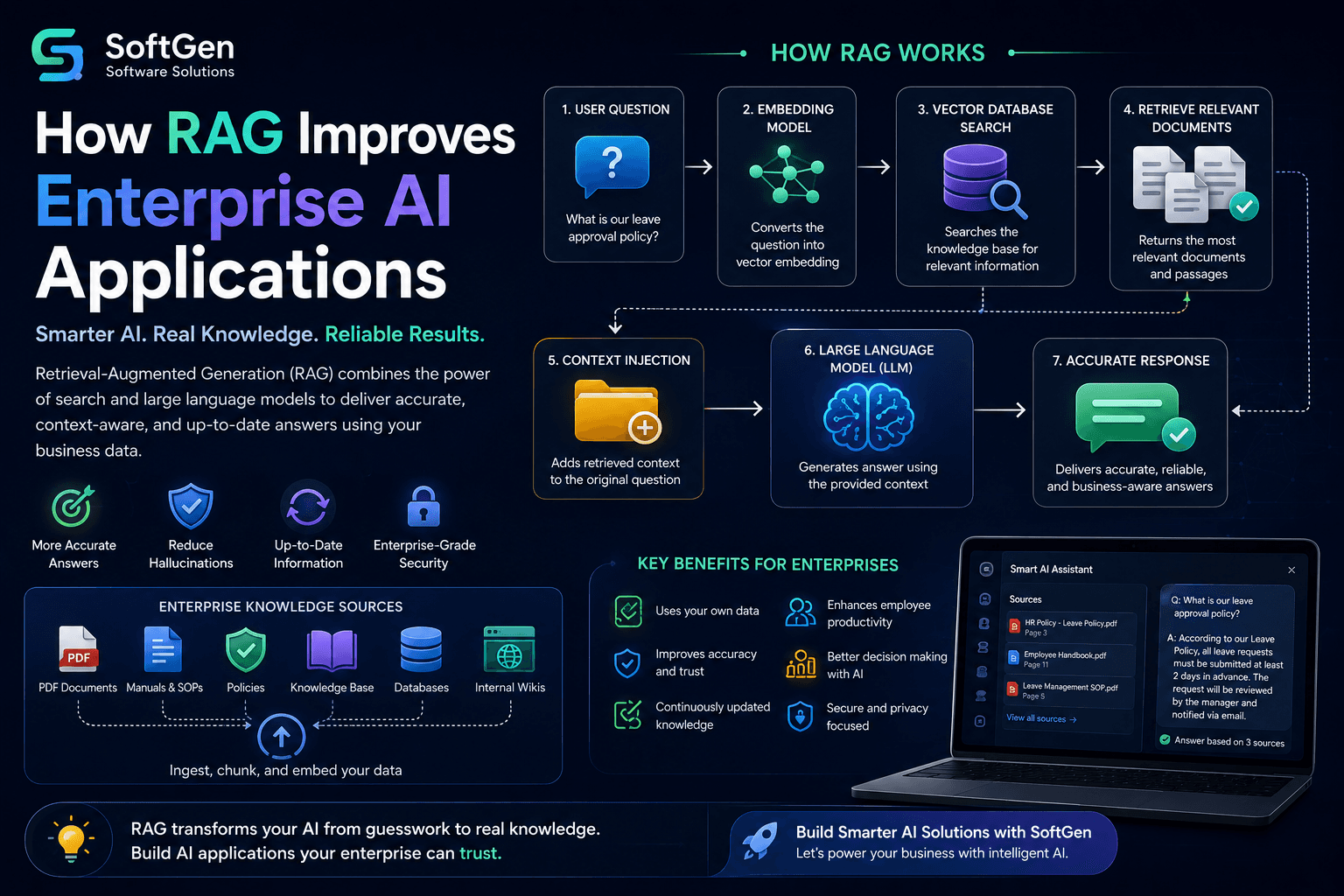
Why This Matters
Large Language Models are powerful, but they have a fundamental limitation: they only know what they were trained on. They cannot access your company's policies, manuals, contracts, or internal documentation.
This creates a critical gap. Businesses need AI that understands their specific knowledge, not just general internet information. Without access to company context, AI systems produce generic answers, miss important details, and can even hallucinate information.
Retrieval-Augmented Generation (RAG) solves this by connecting AI to your enterprise knowledge base. Instead of relying solely on pre-trained data, RAG retrieves relevant documents in real-time and uses them to generate accurate, grounded, and business-aware responses.
What Is RAG?
RAG is an AI architecture that combines information retrieval with large language models to produce more accurate and context-aware responses.
Unlike traditional AI that relies only on training data, RAG searches your company documents in real-time, retrieves relevant information, and provides it to the LLM as context before generating a response.
RAG can retrieve information from:
Traditional AI vs RAG-Powered AI
| Feature | Traditional AI | RAG-Powered AI |
|---|---|---|
| Knowledge | General knowledge only | Uses company knowledge |
| Accuracy | Can hallucinate | Grounded in real documents |
| Updates | Static training data | Continuously updated |
| Memory | No business memory | Enterprise knowledge aware |
| Reliability | Less reliable | Higher accuracy |
| Responses | Generic responses | Context-aware answers |
RAG transforms AI from a generic knowledge tool into a business-aware system that understands your organization's context.
How RAG Works
RAG combines knowledge retrieval with AI generation to deliver accurate, context-aware responses grounded in your business documents.
Free RAG Architecture Consultation
Build Smarter AI with Enterprise Knowledge
Our AI team will analyze your knowledge infrastructure, design a RAG architecture, and recommend the best approach for connecting AI to your enterprise documents - completely free.
Core Components of RAG
Knowledge Base
Stores business information such as policies, manuals, PDFs, contracts, SOPs, product documentation, knowledge articles, and wikis.
Embedding Model
Converts documents into numerical vectors that capture semantic meaning. This enables AI to understand concepts rather than relying only on keyword matching.
Vector Database
Stores embeddings for fast semantic search. Popular options include pgvector, Pinecone, Weaviate, Qdrant, and Milvus.
Retrieval Layer
Searches the vector database to find the most relevant documents. Instead of searching exact words, it searches meaning.
Large Language Model
Finally, the retrieved documents are provided to the LLM, allowing it to generate accurate, context-aware answers.
Real-World Enterprise Use Cases
- Answer customer questions
- Access latest documentation
- Resolve tickets faster
- Reduce support workload
- Improve response quality
- Leave policy queries
- Benefits information
- Onboarding guidance
- Internal procedures
- Compliance questions
- Medical guidelines
- Patient documentation
- Clinical protocols
- Research papers
- Treatment procedures
- Compliance documents
- Financial reports
- Regulatory requirements
- Audit procedures
- Policy information
- Curriculum materials
- Student resources
- Research papers
- Academic policies
- Course documentation
- Contract analysis
- Legal precedents
- Regulatory compliance
- Internal knowledge
- Case documentation
Benefits of RAG for Enterprise AI
Technologies Behind RAG
Common Challenges
Implementing RAG successfully requires addressing several technical and architectural challenges.
- ×Document chunking
- ×Embedding optimization
- ×Search relevance
- ×Vector indexing
- ×Context window limits
- ×Security controls
- ×Access permissions
- ×Response latency
- ×Knowledge freshness
These challenges can be addressed through proper RAG architecture, testing, and continuous optimization of retrieval and generation pipelines.
Best Practices
- Use trusted knowledge sources
- Keep documents updated
- Apply role-based access control
- Optimize document chunk sizes
- Monitor retrieval quality
- Evaluate AI responses regularly
- Secure vector databases
- Log AI interactions for auditing
Why Choose SoftGen?
At SoftGen, we design and build enterprise RAG solutions that connect AI to your organization's knowledge.
We help organizations build AI systems that understand their business, reduce hallucinations, and deliver reliable, context-aware responses.
Final Thoughts
RAG transforms enterprise AI by connecting language models to real business knowledge. Instead of relying solely on pre-trained data, RAG retrieves relevant documents in real-time and uses them to generate accurate, grounded responses.
By implementing RAG, businesses can reduce hallucinations, improve accuracy, keep AI systems up-to-date, and build trustworthy AI applications that understand their specific context.
Organizations that invest in RAG architecture today will be better equipped to deploy reliable AI systems, improve decision-making, and stay competitive in the AI-powered enterprise landscape.
Frequently Asked Questions
What does RAG stand for?
RAG stands for Retrieval-Augmented Generation, an AI architecture that combines information retrieval with large language models to produce more accurate responses.
Does RAG replace Large Language Models?
No. RAG works alongside LLMs by providing relevant context before the model generates a response.
Why is RAG important for enterprises?
RAG enables AI to answer using company-specific documents, reducing hallucinations and improving accuracy while keeping information current.
Can RAG work with private company documents?
Yes. One of the biggest advantages of RAG is its ability to securely retrieve information from internal knowledge bases, policies, manuals, and documentation without exposing sensitive data publicly.
Ready to Build Smarter AI with RAG?
Let's connect your AI to enterprise knowledge
Whether you are building a knowledge-powered chatbot, document search system, or enterprise AI platform, SoftGen can help you design and develop secure, scalable RAG solutions tailored to your business.