How Multi-Agent AI SystemsWork
Multiple intelligent agents. One shared goal. Smarter, faster, and built for enterprise.
Why This Matters
Artificial Intelligence is no longer a single model answering questions. The next wave of enterprise AI is built on collaboration — multiple intelligent agents working together toward a shared goal.
A single AI model can handle simple tasks well. But when your business needs to research, plan, execute, verify, and remember across complex workflows — one model is not enough.
Multi-Agent AI Systems solve this by dividing work among specialized agents. Each agent focuses on what it does best — researching, executing, evaluating, or remembering — while an orchestrator coordinates everything.
The result? Faster execution, higher accuracy, better scalability, and enterprise-grade AI automation that grows with your business.
What Is a Multi-Agent AI System?
A Multi-Agent AI System is an architecture where multiple specialized AI agents collaborate to solve complex tasks. Instead of relying on a single model, the system distributes work across agents — each designed for a specific purpose.
Unlike standalone AI assistants, Multi-Agent Systems operate as a coordinated team. One agent might research information, another executes actions, while a third verifies results — all working in harmony under an orchestrator.
Multi-Agent Systems can:
Single AI vs Multi-Agent Systems
| Feature | Single AI Model | Multi-Agent AI |
|---|---|---|
| Handling | One AI handles every request | Multiple specialized AI agents collaborate |
| Scalability | Limited scalability | Highly scalable |
| Speed | Slower for complex tasks | Parallel task execution |
| Maintenance | Difficult to maintain | Modular architecture |
| Fault Tolerance | One point of failure | Fault-tolerant design |
| Specialization | Limited specialization | Domain-specific intelligence |
Multi-Agent Systems represent a significant evolution beyond single-model AI architectures.
How Multi-Agent AI Systems Work
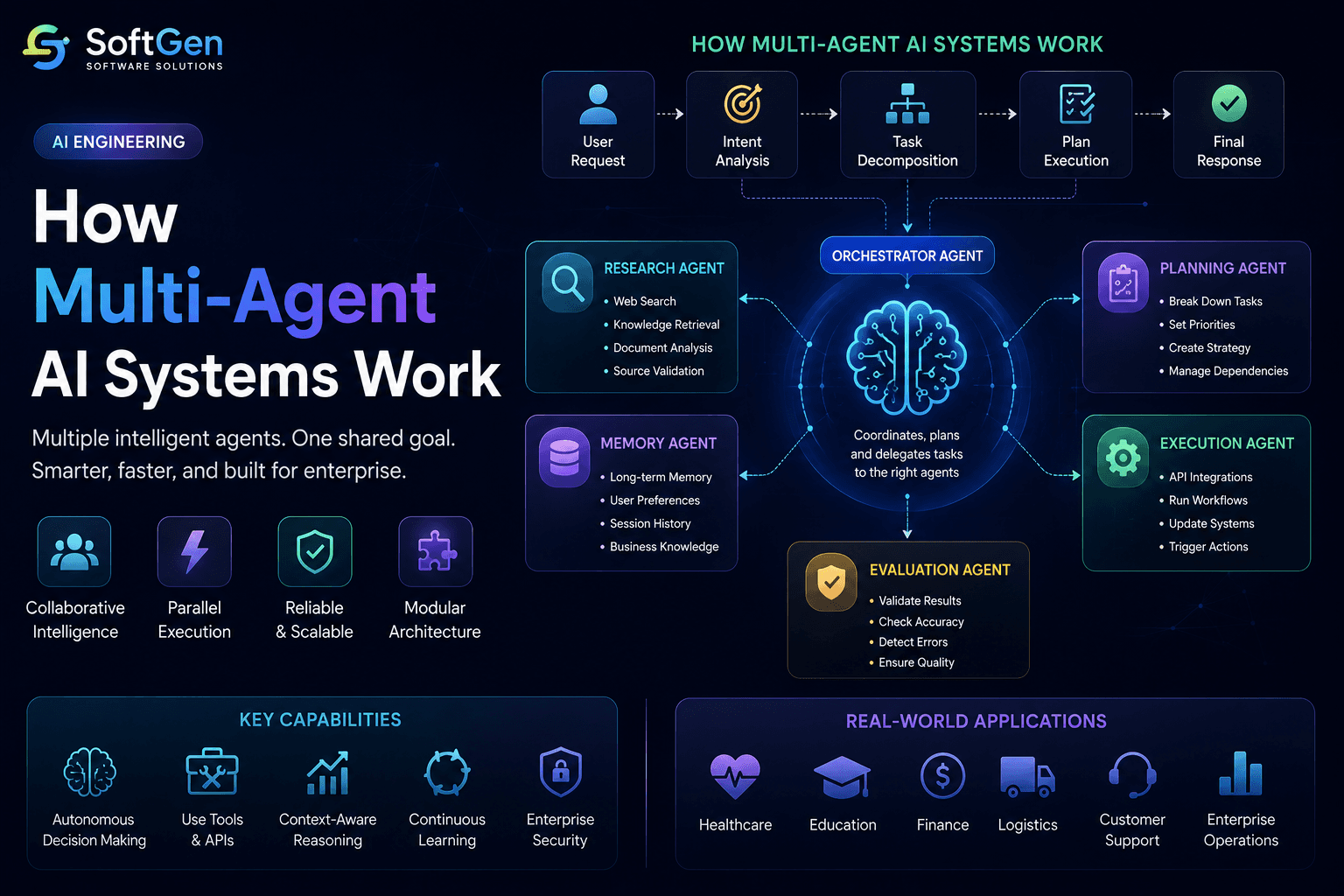
Multi-Agent AI combines specialized agent collaboration with orchestrator-driven coordination to deliver intelligent enterprise automation.
Free Multi-Agent AI Architecture Consultation
Build Intelligent Multi-Agent AI for Your Enterprise
Our AI team will analyze your business workflows, identify multi-agent opportunities, and recommend the best architecture for implementing collaborative AI in your organization — completely free.
Core Components of Multi-Agent AI
Orchestrator Agent
The Orchestrator acts as the central coordinator — understanding user intent, selecting the right agents, managing workflows, combining responses, and monitoring execution.
Research Agent
Responsible for gathering information through web search, knowledge retrieval, vector database search, document analysis, and source validation.
Planning Agent
Creates execution strategies by breaking large tasks into smaller steps, setting priorities, creating plans, and managing dependencies.
Execution Agent
Performs real actions like sending emails, creating reports, updating databases, calling APIs, and scheduling meetings.
Memory Agent
Maintains context through long-term memory, user preferences, previous conversations, business knowledge, and session history.
Evaluation Agent
Reviews the quality of results through fact checking, detecting hallucinations, measuring confidence, verifying outputs, and quality assurance.
Real-World Business Use Cases
- AI Tutors
- Exam Generation
- Personalized Learning
- Student Analytics
- Patient Triage
- Medical Documentation
- Appointment Scheduling
- Clinical Decision Support
- Fraud Detection
- Invoice Processing
- Financial Reporting
- Risk Analysis
- Route Optimization
- Fleet Management
- Warehouse Automation
- Delivery Tracking
- Intelligent Ticket Routing
- Knowledge Search
- Automated Responses
- Workflow Automation
Benefits of Multi-Agent AI Systems
Technologies Behind Multi-Agent AI
Common Challenges
Implementing Multi-Agent AI successfully requires addressing several architectural and operational challenges.
- ×Agent coordination
- ×Memory synchronization
- ×Latency optimization
- ×Cost management
- ×Security
- ×Observability
- ×Error recovery
These challenges can be addressed through proper agent design, robust orchestration, and continuous monitoring.
Best Practices
- Design clear agent responsibilities
- Implement robust orchestration
- Use standardized communication protocols
- Monitor agent performance in real-time
- Apply role-based access control
- Log all agent interactions
- Build graceful error recovery
Why Choose SoftGen?
At SoftGen, we design and build Multi-Agent AI solutions tailored to your enterprise needs.
We help organizations build intelligent multi-agent systems that automate complex workflows, improve accuracy, and scale their operations with collaborative AI.
Final Thoughts
Multi-Agent AI Systems represent the future of enterprise AI. By combining specialized agents with intelligent orchestration, businesses can build automation that is faster, more reliable, and infinitely more scalable.
Whether you are automating customer support, optimizing logistics, or building enterprise-grade AI platforms — Multi-Agent Systems provide the architecture to make it happen.
Organizations that invest in Multi-Agent AI today will be better equipped to handle complex workflows, reduce costs, and stay ahead in the AI-powered economy.
Frequently Asked Questions
What is a Multi-Agent AI System?
A Multi-Agent AI System is an architecture where multiple specialized AI agents work together to solve complex tasks more efficiently than a single AI model.
Are Multi-Agent Systems better than traditional chatbots?
For complex workflows, yes. Multi-Agent Systems provide greater scalability, specialization, and automation. Traditional chatbots remain useful for simpler conversational tasks.
Can Multi-Agent AI integrate with existing business software?
Yes. Modern Multi-Agent platforms can connect to CRMs, ERPs, databases, cloud services, APIs, and internal business applications to automate real-world operations.
What industries benefit most from Multi-Agent AI?
Healthcare, education, finance, logistics, retail, manufacturing, customer support, and enterprise SaaS are among the industries that benefit significantly from Multi-Agent AI.
Ready to Build Your Multi-Agent AI System?
Let's build a collaborative AI solution for your enterprise
Whether you are building multi-agent workflows, AI orchestration platforms, or enterprise-grade automation systems, SoftGen can help you design and develop secure, scalable, and intelligent Multi-Agent AI solutions tailored to your business.