Building ZisuGen for theGoogle for Startups AI Agents Challenge
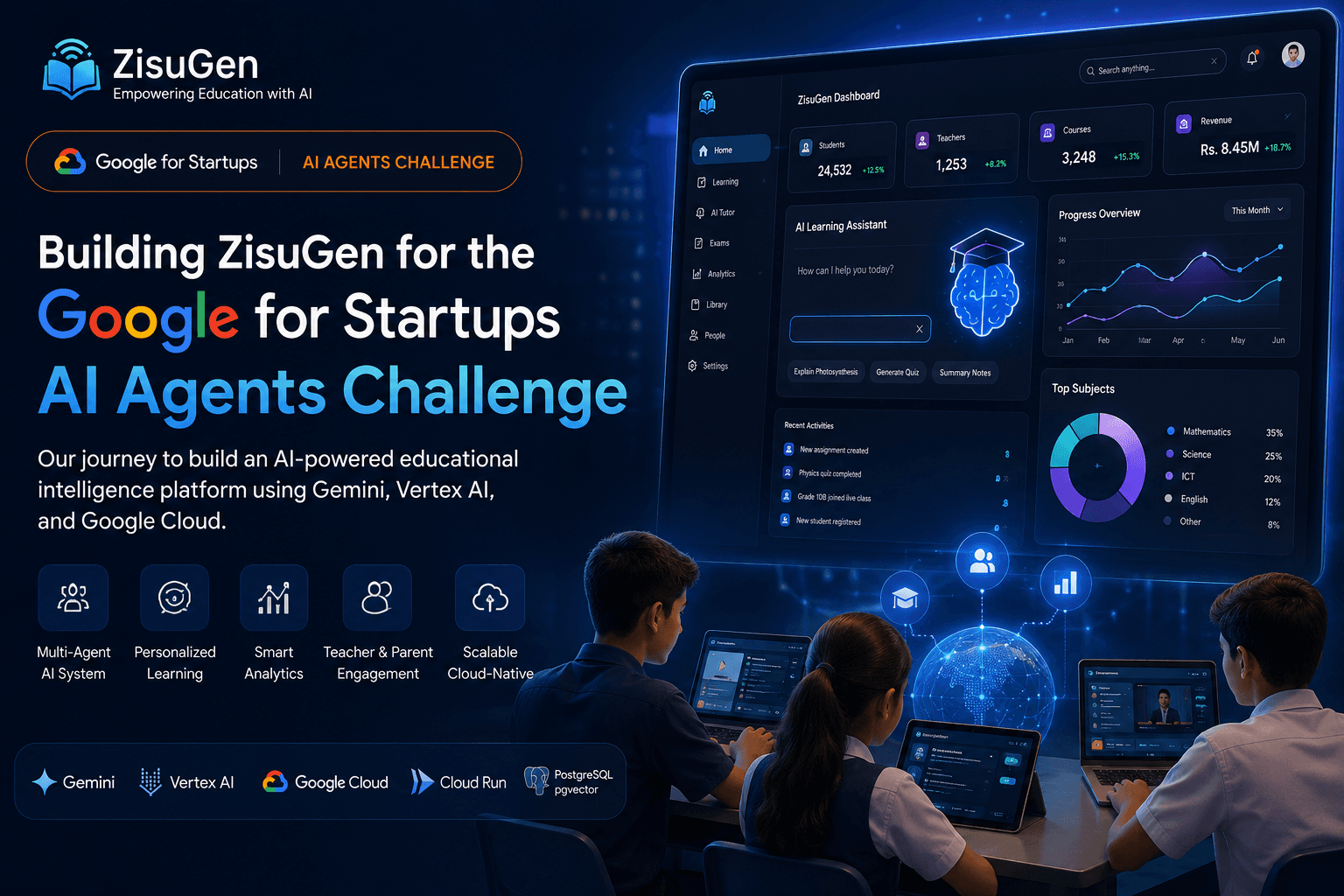
How SoftGen designed and built ZisuGen, an AI-powered educational intelligence platform that was submitted to the Google for Startups AI Agents Challenge, leveraging Google's latest AI technologies to solve real educational challenges in Sri Lanka.
From a Local Problem to an AI Platform
Every great software product begins with a real-world problem.
For us, that problem was education.
Students struggled to organize learning materials across multiple platforms. Teachers spent valuable hours on administrative work instead of teaching. Parents lacked visibility into student progress, and institutions relied on disconnected tools that couldn't communicate with each other.
Instead of solving these problems separately, we asked a different question:
What if the entire education ecosystem could operate as one intelligent platform?
That question became ZisuGen.
Enter the Google for Startups AI Agents Challenge
When Google announced the Google for Startups AI Agents Challenge, we saw more than a hackathon.
We saw an opportunity to validate our architecture against one of the world's leading AI ecosystems.
The challenge encouraged startups to build production-ready AI systems using technologies such as Gemini, Google Cloud, Vertex AI, and modern agent architectures.
Rather than building a demo, we decided to submit a real product already designed for real users.
What is ZisuGen?
ZisuGen is an AI-powered educational intelligence platform designed for students, teachers, parents, and educational institutions.
The platform combines learning management, academic administration, AI tutoring, analytics, and intelligent automation into a unified ecosystem.
Our Technical Vision
Instead of relying on a single AI model, we designed a multi-agent architecture where different AI components specialize in different tasks.
This architecture allows the platform to balance:
- Fast responses for real-time interactions
- Deep reasoning for complex educational queries
- Curriculum-aware answers aligned with local syllabi
- Personalized learning paths for individual students
- Intelligent routing across specialized agent workflows
According to our submission, ZisuGen routes requests through multiple cognitive modes and specialized agent workflows to deliver the right response for each educational scenario.
Technologies Behind ZisuGen
The platform was built using a modern cloud-native stack, including:
Solving Local Challenges
Building educational AI for Sri Lanka introduced challenges that many global platforms never encounter.
These included:
- Legacy Sinhala font conversion for older educational materials
- Local syllabus support aligned with Sri Lankan curriculum
- Offline-first requirements for areas with limited connectivity
- Hybrid classroom workflows for in-person and remote learning
- Local payment practices and banking integration
Addressing these challenges required custom engineering rather than generic AI integrations.
Why We Built Our Own AI Orchestrator
One of our biggest engineering decisions was to develop a custom orchestration layer instead of depending entirely on generic agent frameworks.
This gave us greater control over:
- Request routing across multiple AI models
- Model selection based on task complexity
- Performance optimization for low latency
- Token efficiency for cost management
- Educational accuracy for curriculum-aligned responses
The architecture dynamically combines Gemini models, Vertex AI, Groq, and direct vector database queries to optimize responses for different workloads.
Beyond the Competition
For us, the Google for Startups AI Agents Challenge was never just about submitting a project.
It was an opportunity to validate our engineering approach, strengthen our architecture, and continue building software that solves meaningful problems.
Regardless of competition outcomes, the experience pushed us to improve reliability, scalability, and product quality.
Looking Ahead
ZisuGen continues to evolve as we expand its AI capabilities, strengthen its educational intelligence engine, and improve the learning experience for students, teachers, and institutions.
At SoftGen, we believe the future of education will be powered not by isolated tools, but by intelligent ecosystems that help people learn more effectively.
Ready to build AI-powered software?
Let's create your next AI platform
Whether you're creating an AI platform, modernizing an existing product, or building enterprise software from the ground up, SoftGen helps transform ambitious ideas into production-ready systems.