AI Voice Assistantsfor Businesses
The Complete Guide to Enterprise Voice AI
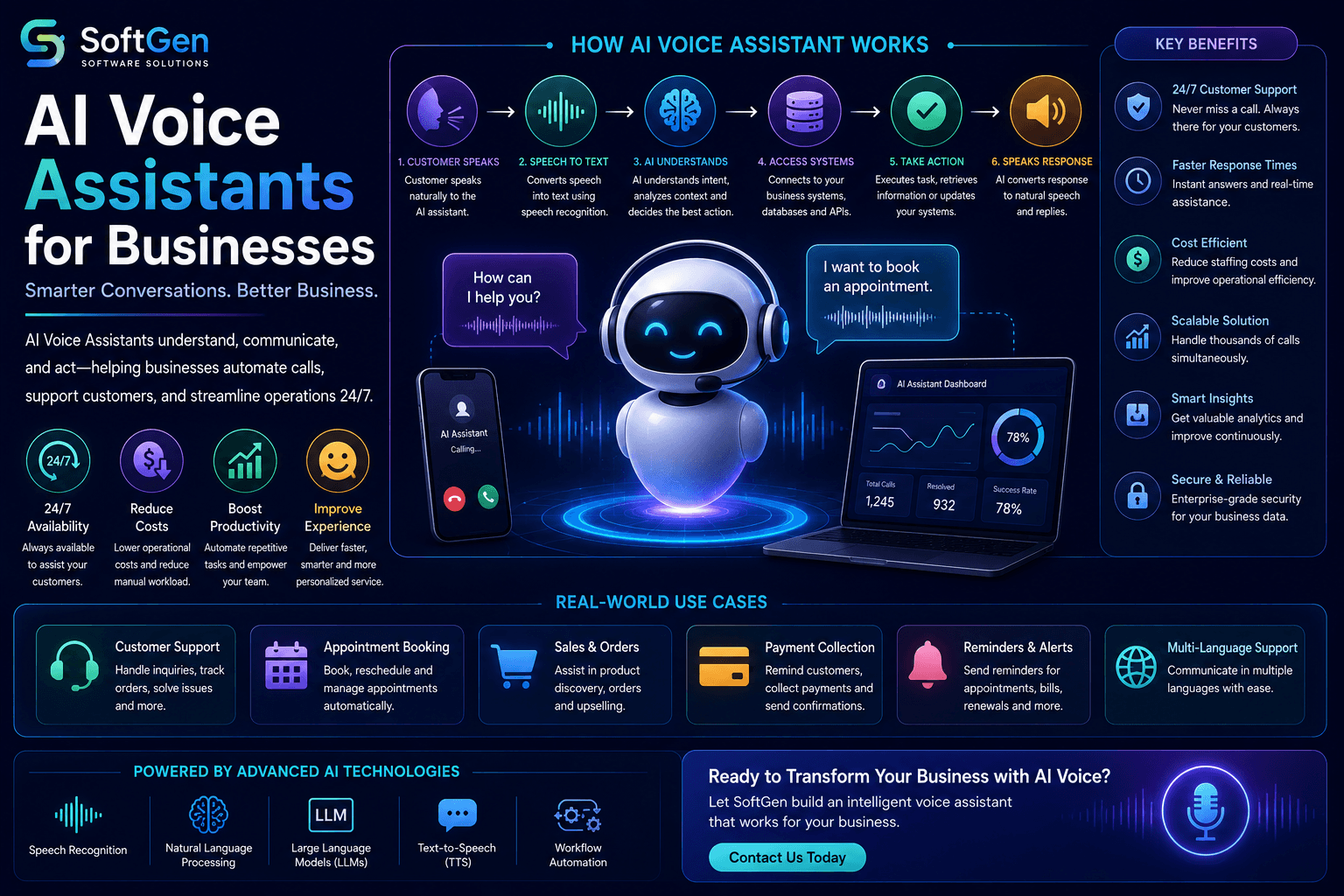
Why This Matters
Phone calls remain the most trusted channel for customer communication. Every business depends on voice interactions for sales, support, and operations.
Yet most organizations still rely on traditional IVR systems with rigid menu trees, long hold times, and limited capabilities that frustrate customers and drain resources.
This approach is slow, expensive, and scales poorly. A single missed call or botched handoff can lead to lost revenue, poor customer satisfaction, and overwhelmed support teams.
AI Voice Assistants change this. By combining speech-to-text, natural language understanding, and real-time dialogue management, businesses can automate phone interactions at scale — delivering natural, intelligent conversations that resolve issues without human intervention.
What Are AI Voice Assistants?
AI Voice Assistants are intelligent phone systems powered by Artificial Intelligence that can answer calls, understand natural language, resolve customer queries, and execute business actions — all without human agents.
Unlike traditional IVR systems that force callers through menu trees, AI Voice Assistants understand what callers actually want, hold natural conversations, and handle complex multi-step workflows end to end.
AI Voice Assistants can handle:
Traditional IVR vs AI Voice Assistants
| Feature | Traditional IVR | AI Voice Assistant |
|---|---|---|
| Language | Limited menu options | Natural language understanding |
| Availability | Business hours only | 24/7 always-on |
| Scalability | Fixed call capacity | Unlimited concurrent calls |
| Personalization | Generic responses | Context-aware personalization |
| Learning | Static scripts | Continuous learning |
| Cost | Scales linearly with staff | Scales without additional headcount |
AI Voice Assistants represent a fundamental shift beyond legacy telephony systems.
How AI Voice Assistants Work
AI combines voice processing with intelligent dialogue management to deliver real-time, natural phone conversations at scale.
Free AI Voice Assistant Consultation
Automate Your Phone Operations with AI
Our AI team will analyze your call flows, identify automation opportunities, and recommend the best approach for implementing AI Voice Assistants in your organization — completely free.
Core Components of AI Voice Assistants
Speech-to-Text (STT)
Converts caller audio into text in real-time. Supports multiple languages, accents, and noisy call center environments.
Natural Language Understanding (NLU)
Interprets caller intent, extracts key entities, and understands context beyond simple keyword matching.
Dialogue Management
Manages conversation flow, handles interruptions, and guides callers through resolution paths.
Text-to-Speech (TTS)
Generates natural-sounding voice responses with human-like intonation and pacing.
Integration Layer
Connects to CRM, ERP, databases, and business systems to retrieve data and execute actions during calls.
Real-World Business Use Cases
- Inbound call handling
- Issue resolution
- Account inquiries
- FAQ automation
- Complaint management
- Appointment scheduling
- Patient intake
- Prescription refills
- Symptom triage
- Insurance verification
- Account balance checks
- Transaction disputes
- Loan applications
- Fraud alerts
- Payment processing
- Order tracking
- Returns processing
- Product inquiries
- Delivery scheduling
- Loyalty programs
- Property inquiries
- Showing scheduling
- Lead qualification
- Tenant screening
- Maintenance requests
- Delivery updates
- Route inquiries
- Driver dispatch
- Shipment tracking
- Customer notifications
Benefits of AI Voice Assistants
Technologies Behind AI Voice Assistants
Common Challenges
Implementing AI Voice Assistants successfully requires addressing several challenges.
- ×Accents and speech variations
- ×Background noise and call quality
- ×Complex multi-turn conversations
- ×Emotional caller handling
- ×Regulatory compliance (PCI-DSS, HIPAA)
- ×Integration with legacy telephony
- ×Latency and response time expectations
- ×Maintaining conversation context
These challenges can be addressed through proper AI architecture, testing, and continuous improvement.
Best Practices
- Start with high-volume, low-complexity call types
- Always provide a clear path to a human agent
- Record and transcribe calls for quality assurance
- Continuously train with real call data
- Monitor sentiment metrics in real-time
- Ensure PCI-DSS compliance for payment calls
- Design fail-safe escalation paths
- A/B test different voice personas
Why Choose SoftGen?
At SoftGen, we design and build intelligent voice AI solutions tailored to your business.
We help organizations eliminate repetitive call handling, reduce costs, and scale their phone operations with AI-powered voice automation.
Final Thoughts
AI Voice Assistants combine speech-to-text, natural language understanding, dialogue management, and text-to-speech to automate phone interactions at enterprise scale.
By automating call handling, appointment scheduling, payment processing, and customer support, businesses can reduce costs, improve resolution rates, and deliver 24/7 service without additional staffing.
Organizations that invest in AI Voice Assistants today will be better equipped to scale operations, improve customer satisfaction, and stay competitive in the digital economy.
Frequently Asked Questions
What are AI Voice Assistants for businesses?
AI Voice Assistants are AI-powered systems that handle phone calls using natural language understanding, speech-to-text, text-to-speech, and dialogue management. They can resolve customer queries, process transactions, and handle complex call flows without human intervention.
How are AI Voice Assistants different from traditional IVR?
Traditional IVR uses rigid menu trees (press 1 for sales, press 2 for support). AI Voice Assistants understand natural language, handle complex requests, and provide personalized responses — no more "press 1" loops.
Can AI Voice Assistants handle multiple languages?
Yes. Modern AI Voice Assistants support real-time language detection, multi-language speech recognition, and natural language responses in dozens of languages.
What is the ROI of implementing AI Voice Assistants?
Businesses typically see 40-70% reduction in call handling costs, 20-35% improvement in first-call resolution, and the ability to handle unlimited concurrent calls without additional staffing.
Can AI Voice Assistants integrate with our existing phone system?
Yes. They integrate with existing telephony systems (PBX, SIP, VoIP), CRM platforms (Salesforce, HubSpot), and business applications via APIs and standard protocols like SIP and WebRTC.
Ready to Automate Your Phone Operations?
Let's build an AI voice assistant for your business
Whether you are automating customer support, scheduling appointments, or building a complete voice AI platform, SoftGen can help you design and develop secure, scalable, and enterprise-ready AI Voice Assistant solutions tailored to your business.