AI-Native Software Architecture:Engineering Enterprise Platforms in 2026
Moving past basic chat wrappers. Discover how enterprise systems are rebuilt around autonomous agent coordination, event-driven streaming pipelines, hybrid vector-relational databases, and deterministic security gates.
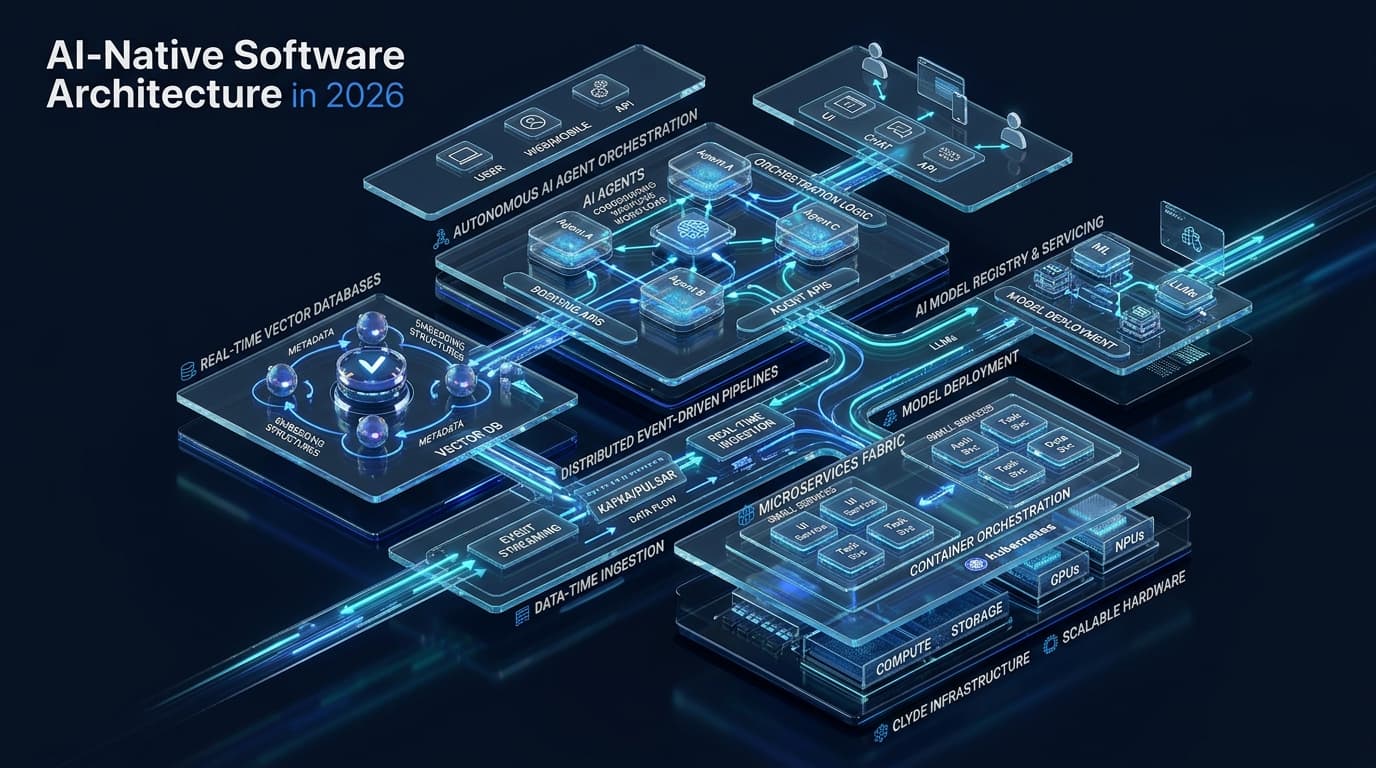
From Simple LLM Integrations to Enterprise AI-Native Platforms
In 2023 and 2024, many companies “added AI” by creating a basic prompt wrapper that sent raw customer queries to an external model endpoint. In 2026, this approach has proven commercially unviable: it introduces uncontrollable latency, exorbitant token bills, catastrophic hallucinations, and zero defensibility.
AI-Native Software Architecture represents a complete paradigm shift. Here, autonomous intelligence is not a feature tacked onto a web page; it is the central operational fabric that coordinates business processes, analyzes multi-modal signals, and triggers verified transactions through hardened microservices.
Traditional Monolithic/Microservices vs. AI-Native Fabric
Comparing how modern platforms solve complex data routing, workflow automation, and state management compared to traditional web development:
| Dimension | Traditional Software (2018-2024) | AI-Native Software (2026+) |
|---|---|---|
| Design Core | Relational CRUD & static REST controllers | Agentic orchestration, event loops & semantic pipelines |
| State Management | Session cookies & database row locks | Context window budgets, vector state & episodic memory |
| Query Resolution | Exact SQL WHERE clauses & full-text search | Hybrid lexical + semantic dense vector search |
| Execution Path | Hardcoded if/else branching workflows | Adaptive multi-agent reasoning with deterministic tool gates |
| Caching Strategy | Key-value Redis string caches (Exact Key) | Semantic vector similarity caching (Distance Thresholds) |
| Failure Tolerance | Unhandled exceptions & manual retries | Autonomous self-healing, reflection loops & fallback models |
The 4 Foundational Tiers of an AI-Native System
Every enterprise-grade AI solution engineered by SoftGen is structured into four decoupled, highly resilient operational tiers:
Semantic Gateway & Edge Ingress
Directs incoming requests through semantic firewalls, model-agnostic routing, rate-limiting, and instantaneous semantic caching. Eliminates up to 68% of repetitive LLM invocations by serving near-identical prompts from vector caches in sub-12ms.
Autonomous Agent Orchestration Fabric
Deconstructs high-level enterprise goals into deterministic, multi-step execution graphs. Agents communicate through standard protocols (like MCP), self-correct on execution failures, and maintain persistent state across distributed transactions.
Hybrid Storage: Vector & Relational Fabric
Unifies transactional ACID data (PostgreSQL with UUIDv7, tenant isolation) with real-time vector embeddings (pgvector, Qdrant). Enables simultaneous lexical, metadata, and dense embedding retrieval in a single query transaction.
Deterministic Tool Execution & Microservices
AI agents never execute unverified database writes. Instead, agents invoke hardened, type-safe internal domain APIs protected by strict RBAC, automated parameter validation (Zod schemas), and immutable audit logs.
Non-Negotiable Principles for Production AI Systems
1. Strict Separation of AI & Domain Logic
Never embed non-deterministic LLM outputs directly into critical financial or operational ledgers. AI proposes actions; deterministic Domain Services validate, sanitize, and persist transactions.
2. Zero-Leakage Tenant Isolation
Multi-tenant enterprise platforms require physical or row-level tenant boundary isolation in both relational tables and vector embedding namespaces to guarantee zero data bleeding across corporate clients.
3. Semantic Caching as a First-Class Citizen
Public and private LLM tokens carry latency and cost penalties. By implementing cosine similarity semantic caching, repeated user queries resolve in milliseconds at zero token expense.
4. Immutable Auditability & Replayability
Every prompt, model checkpoint, tool invocation, and returned payload must be recorded with UUID v7 timestamps in an append-only audit trail for compliance, SOC2 certification, and debugging.
Clean Architecture & Enterprise Governance
At SoftGen, we never write MVC spaghetti code or allow AI agents direct unrestricted access to database tables. Every system we build adheres strictly to Domain-Driven Design (DDD) and Clean Architecture:
The result is an enterprise platform that delivers the transformative autonomy of artificial intelligence while maintaining the rock-solid predictability, auditability, and speed of high-performance software engineering.
Architecture & Implementation FAQs
What defines an application as 'AI-Native' versus 'AI-Wrapped'?
An 'AI-wrapped' app simply makes an API call to OpenAI from an existing traditional CRUD backend. An 'AI-Native' application is architected from inception around autonomous agent coordination, event-driven streaming, hybrid vector/relational databases, semantic caching, and dynamic tool invocation layers.
Why is hybrid search (SQL + pgvector) superior to standalone vector DBs?
Standalone vector databases often force applications to manage dual consistency between business data and embeddings. Using PostgreSQL with pgvector provides ACID transactional integrity, single-connection transactions, strict row-level tenant isolation, and joins between relational tables and vector similarity indices.
How does AI-Native software maintain enterprise security standards?
By enforcing clean architecture: AI models interact solely with structured MCP tools that mandate schema validation (Zod DTOs), user permission checks, rate limiting, and write operations through hardened Domain Repositories rather than raw SQL generation.
What tech stack does SoftGen use to engineer AI-Native systems?
We engineer AI-Native platforms with Next.js 15 Server Components, TypeScript, Node.js/Python microservices, PostgreSQL with pgvector, Prisma ORM, Redis for semantic caching, and Model Context Protocol (MCP) for tool orchestration.
Build with Senior Engineers
Architect Your AI-Native Enterprise Platform Today
Whether you need to overhaul an existing monolithic system or build an intelligent multi-agent platform from scratch, SoftGen’s senior engineers bring the architecture, rigor, and speed your company needs.