AI DocumentProcessing Explained
Transform Paperwork into Intelligent Business Workflows with AI
Why This Matters
Every business depends on documents. Invoices, contracts, receipts, reports, applications, and records are the backbone of daily operations.
Yet most organizations still process documents manually — copying data by hand, filing papers into folders, and spending hours on repetitive administrative tasks.
This approach is slow, error-prone, and expensive. A single misread invoice or misplaced contract can lead to costly mistakes, compliance violations, and lost productivity.
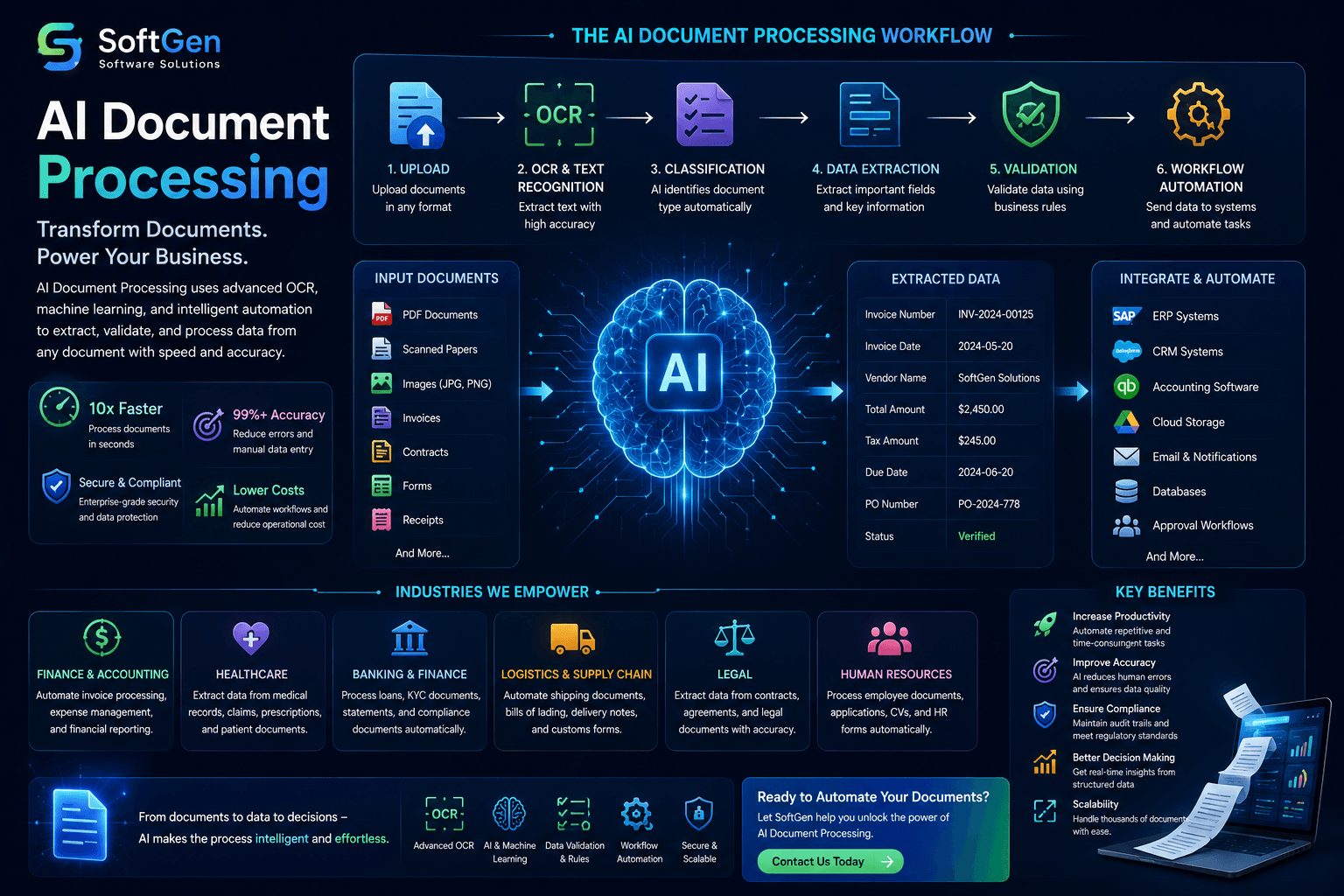
AI Document Processing changes this. By combining OCR, AI understanding, and workflow automation, businesses can transform paperwork into intelligent, automated workflows that save time, reduce errors, and scale effortlessly.
What Is AI Document Processing?
AI Document Processing is the use of Artificial Intelligence to automatically read, understand, extract, and validate data from documents.
Unlike traditional OCR that only converts images to text, AI Document Processing understands the meaning behind the data, classifies document types, validates extracted information, and integrates directly with business systems.
AI Document Processing can identify:
Traditional OCR vs AI Document Processing
| Feature | Traditional OCR | AI Document Processing |
|---|---|---|
| Text Conversion | Converts images into text | Understands document meaning |
| Accuracy | Limited accuracy | Context-aware extraction |
| Logic | Rule-based | AI-powered reasoning |
| Verification | Manual verification | Intelligent validation |
| Layouts | Fixed templates | Multiple document layouts |
| Automation | Limited automation | End-to-end document workflows |
AI Document Processing is a significant evolution beyond traditional OCR technology.
How AI Document Processing Works
AI combines document understanding with business system integration to deliver end-to-end document automation.
Free AI Document Processing Consultation
Automate Your Document Workflows with AI
Our AI team will analyze your document processes, identify automation opportunities, and recommend the best approach for implementing AI Document Processing in your organization - completely free.
Core Components of AI Document Processing
OCR
Converts scanned documents and images into editable, searchable text. Supports PDF, JPG, PNG, and TIFF formats.
Document Classification
Automatically identifies document types and routes them to the correct processing pipeline.
Data Extraction
Pulls specific data fields from documents with high accuracy using AI and machine learning.
Validation
Checks extracted data against business rules and external sources to ensure accuracy and completeness.
Workflow Automation
Routes processed documents to the appropriate business systems and triggers automated actions.
Real-World Business Use Cases
- Supplier invoices
- Expense claims
- Purchase orders
- Payment approvals
- Medical records
- Laboratory reports
- Insurance claims
- Referral letters
- Patient registration forms
- Loan applications
- KYC documents
- Bank statements
- Identity verification
- Compliance forms
- Shipping documents
- Bills of Lading
- Customs declarations
- Delivery notes
- Warehouse forms
- Contracts
- Agreements
- Court documents
- Legal correspondence
- Compliance records
- CV screening
- Employee applications
- Payroll forms
- Leave requests
- Employment contracts
Benefits of AI Document Processing
Technologies Behind AI Document Processing
Common Challenges
Implementing AI Document Processing successfully requires addressing several challenges.
- ×Poor scan quality
- ×Handwritten documents
- ×Multiple document layouts
- ×Multi-language support
- ×Large document sizes
- ×Data privacy
- ×Compliance requirements
- ×Low-confidence extractions
These challenges can be addressed through proper AI architecture, testing, and continuous improvement.
Best Practices
- Use high-quality document scans
- Apply human review for low-confidence results
- Encrypt sensitive documents
- Implement role-based access control (RBAC)
- Maintain audit logs
- Validate extracted data
- Continuously train and improve AI models
Why Choose SoftGen?
At SoftGen, we design and build intelligent document processing solutions tailored to your business.
We help organizations eliminate repetitive document work, improve accuracy, and scale their operations with AI-powered automation.
Final Thoughts
AI Document Processing combines OCR, AI understanding, and workflow automation to eliminate repetitive paperwork and improve accuracy.
By automating document classification, data extraction, validation, and routing, businesses can save time, reduce errors, and focus on higher-value work.
Organizations that invest in AI Document Processing today will be better equipped to scale operations, improve compliance, and stay competitive in the digital economy.
Frequently Asked Questions
What is AI Document Processing?
AI Document Processing combines OCR, AI, and workflow automation to automatically extract, classify, and validate data from documents. It transforms paper-based processes into intelligent digital workflows.
Is AI Document Processing better than OCR?
Yes. While OCR only converts images to text, AI Document Processing understands context, validates data, classifies documents, and integrates with business systems for end-to-end automation.
Which industries benefit the most?
Finance, healthcare, banking, logistics, legal, and HR benefit significantly due to their high volume of document-intensive workflows.
Can AI Document Processing integrate with ERP and CRM systems?
Yes. Modern AI document processing solutions integrate seamlessly with ERP systems, CRM platforms, accounting software, and other business applications via APIs.
Ready to Automate Your Document Workflows?
Let's build an AI document processing solution for your business
Whether you are automating invoices, processing contracts, or building a complete document intelligence platform, SoftGen can help you design and develop secure, scalable, and enterprise-ready AI Document Processing solutions tailored to your business.