AI Agents vsAI Chatbots
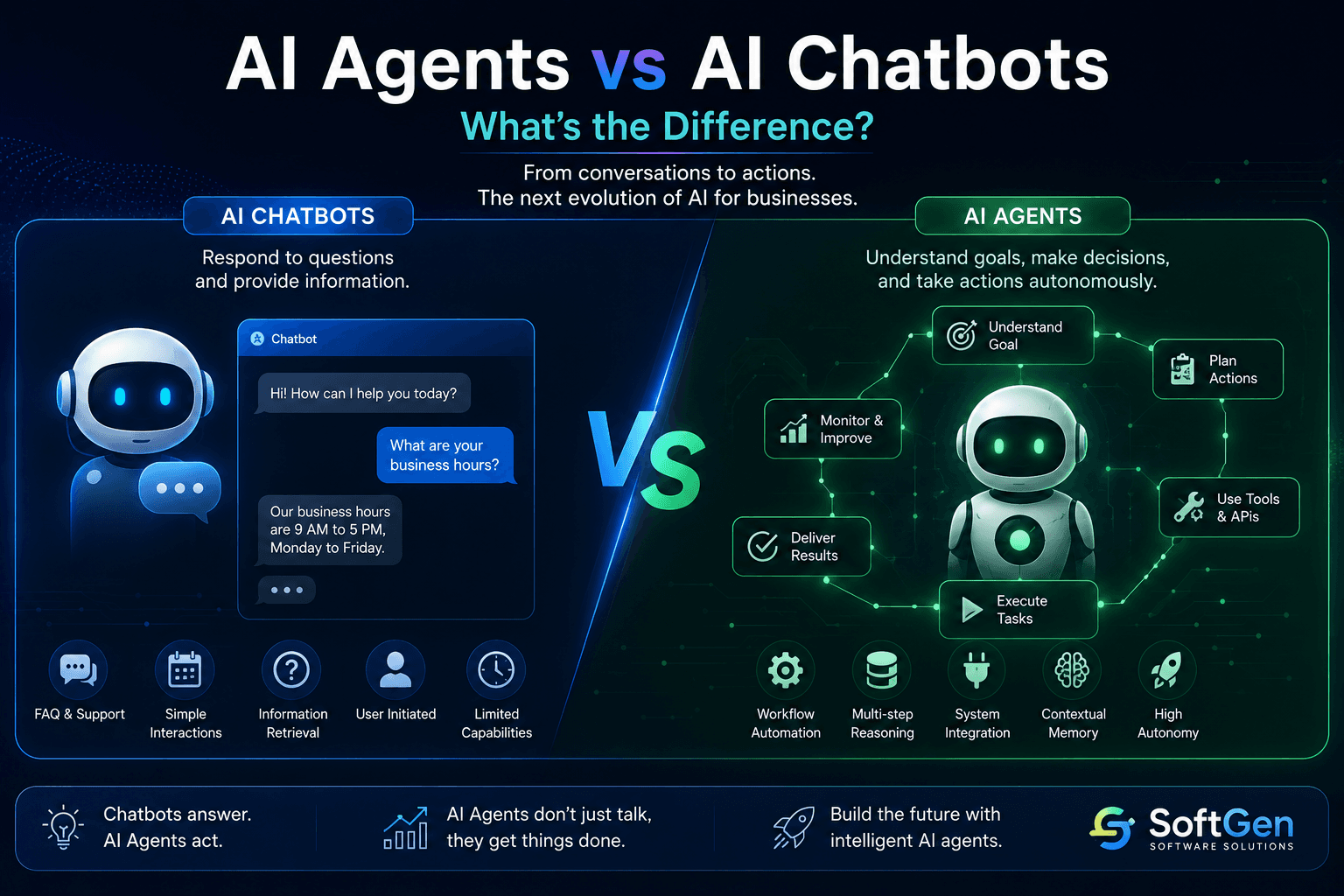
From conversations to actions. The next evolution of AI for businesses.
Why This Matters
AI chatbots have become the standard for customer interactions. They answer questions, handle FAQs, and provide basic support around the clock.
But as businesses grow, the limitations of chatbots become clear. They cannot take action, they do not remember past conversations, and they cannot autonomously complete complex tasks across multiple systems.
This is where AI Agents come in. Unlike chatbots, AI agents can understand goals, plan multi-step workflows, use tools and APIs, make decisions, and execute tasks autonomously — transforming how businesses operate.
What Is an AI Chatbot?
An AI chatbot is a software application that uses Natural Language Processing (NLP) to simulate human-like conversations. It responds to user messages in real time, typically through a chat interface.
AI chatbots are best suited for handling straightforward interactions where the user initiates the conversation and expects a response.
Common use cases include:
What Is an AI Agent?
An AI agent is an autonomous system that can perceive its environment, make decisions, and take actions to achieve specific goals with minimal human intervention.
Unlike chatbots that simply respond to messages, AI agents can plan multi-step workflows, use external tools and APIs, query databases, evaluate results, and continuously improve through feedback loops.
AI agents are designed for complex business automation where the system needs to operate independently across multiple systems and processes.
AI Chatbots vs AI Agents
| Feature | AI Chatbot | AI Agent |
|---|---|---|
| Primary Purpose | Conversation | Task Execution |
| Decision Making | Limited | Advanced |
| Memory | Minimal | Persistent Context |
| API Integration | Basic | Extensive |
| Multi-Step Reasoning | Limited | Yes |
| Workflow Automation | Minimal | Advanced |
| Tool Usage | Rare | Continuous |
| Business Automation | Limited | High |
| Learning Context | Session Based | Long-Term Context |
| Autonomy | Low | High |
AI Agents represent a significant evolution beyond traditional chatbot capabilities.
How AI Agents Work
AI agents combine goal understanding, tool usage, and autonomous decision-making to complete complex business workflows end-to-end.
Free AI Agent Consultation
Build Autonomous AI Systems for Your Business
Our AI team will analyze your business workflows, identify automation opportunities, and recommend the best approach for implementing AI Agents in your organization - completely free.
Core Components of AI Agents
Search Databases
AI agents can query databases, retrieve relevant records, and analyze data to provide informed responses.
Use APIs & Tools
Agents interact with external systems, call APIs, and use business tools to complete real-world tasks.
Execute Workflows
Unlike chatbots, agents can trigger and complete multi-step business workflows automatically.
Make Decisions
AI agents evaluate options, choose the best course of action, and adapt based on context and results.
Monitor & Improve
Agents continuously monitor outcomes, learn from results, and improve their performance over time.
Real-World Business Use Cases
- Patient appointment coordination
- Medical document summarization
- AI triage systems
- Personalized tutoring
- Automatic exam generation
- Student performance analysis
- Invoice processing
- Fraud detection
- Financial reporting
- Route optimization
- Delivery monitoring
- Warehouse automation
- Resume screening
- Interview scheduling
- Employee onboarding
Benefits of AI Agents
Why Choose SoftGen?
At SoftGen, we design and build intelligent AI agent solutions tailored to your business.
We help organizations move beyond basic chatbots to autonomous AI agents that execute tasks, integrate with existing systems, and deliver measurable business outcomes.
Final Thoughts
AI chatbots and AI agents serve different purposes. Chatbots excel at handling conversations and simple interactions, while AI agents are designed for autonomous task execution and complex workflow automation.
As businesses scale, the limitations of chatbots become apparent. AI agents provide the autonomy, decision-making, and tool usage needed to automate real-world business processes.
Organizations that adopt AI agents today will be better equipped to reduce operational costs, improve efficiency, and stay competitive in the age of intelligent automation.
Frequently Asked Questions
Are AI Agents better than chatbots?
Not always. Chatbots are ideal for conversations, while AI Agents are designed for autonomous task execution. The best choice depends on your business needs.
Can AI Agents replace employees?
AI Agents are designed to automate repetitive and data-driven tasks, allowing employees to focus on higher-value work rather than replacing them entirely.
Can AI Agents connect to business software?
Yes. AI Agents can integrate with CRMs, ERPs, databases, cloud services, email platforms, and APIs to automate workflows.
Is an AI Agent more expensive than a chatbot?
Generally, AI Agents require more advanced development and infrastructure than chatbots. However, they often deliver greater long-term value by automating complex business processes.
Ready to Build AI Agents for Your Business?
Let's build autonomous AI agent solutions for your business
Whether you are building AI agents for customer support, workflow automation, or multi-system integration, SoftGen can help you design and develop secure, scalable, and enterprise-ready AI Agent solutions tailored to your business.