Agile vs WaterfallWhich Methodology Is Right for Your Project?
Compare Agile and Waterfall software development methodologies, understand their differences, and discover which approach delivers the best results for your business.
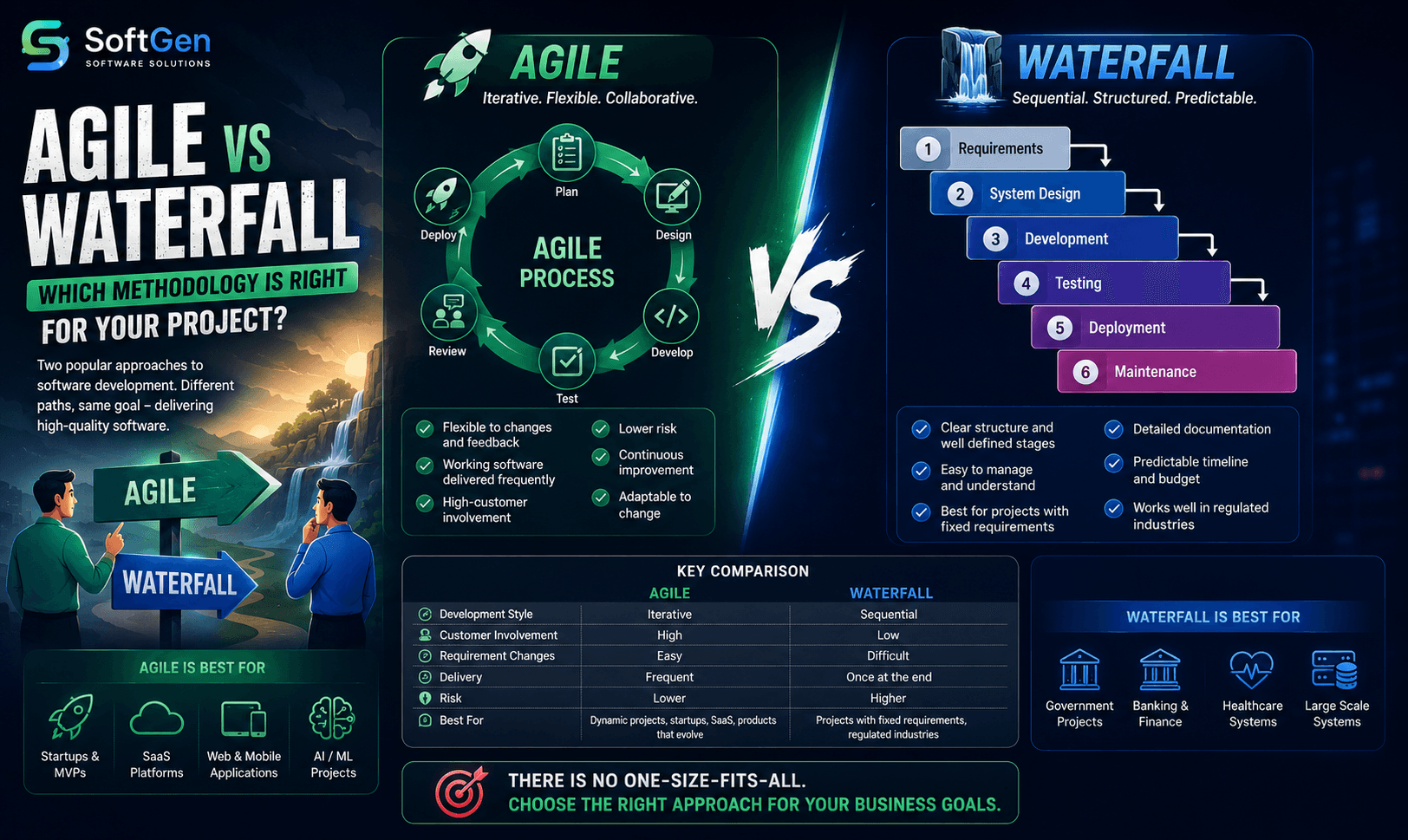
Choosing the Right Development Methodology
Choosing the right software development methodology is just as important as choosing the right technology stack.
A well-planned development process helps teams deliver software faster, reduce project risks, improve collaboration, and ensure the final product meets business goals.
Two of the most widely used software development methodologies are Agile and Waterfall.
Although both aim to deliver high-quality software, they take very different approaches to planning, development, testing, and project management.
In this guide, we will compare Agile and Waterfall, explain their strengths and weaknesses, and help you decide which methodology is right for your project.
What Is Waterfall?
Waterfall is a traditional software development methodology where each phase is completed before moving to the next.
A typical Waterfall process looks like this:
Each stage depends on the successful completion of the previous stage. Changes after development begins can be difficult and expensive.
What Is Agile?
Agile is an iterative software development methodology. Instead of delivering the entire project at once, development is divided into smaller iterations called Sprints.
Each sprint delivers a working version of the software. Teams continuously improve the product based on user feedback.
A simplified Agile workflow looks like this:
This cycle repeats until the project is complete.
Free Project Methodology Consultation
Not Sure Which Methodology Fits Your Project?
Our engineering team will analyze your requirements, timeline, and goals and recommend the best development approach for your project - completely free.
Agile vs Waterfall: 10 Key Differences
| Feature | Agile | Waterfall |
|---|---|---|
| Development Style | Iterative | Sequential |
| Customer Involvement | High | Low |
| Requirement Changes | Easy | Difficult |
| Delivery | Frequent | Once at the end |
| Risk Level | Lower | Higher |
| Testing Phase | Continuous throughout | After development |
| Client Involvement | Every sprint | Mostly at start and end |
| Documentation | Moderate | Extensive |
| Flexibility | Very High | Low |
| Time to First Release | Weeks | Months to years |
Advantages of Agile
Agile is popular because it allows businesses to adapt quickly and deliver value continuously.
- Faster product releases
- Continuous customer feedback
- Easy requirement changes
- Better team collaboration
- Higher product quality
- Lower project risk
- Continuous testing throughout
- Faster bug fixing and iteration
Disadvantages of Agile
Although Agile offers many benefits, it also presents challenges that teams must manage carefully.
- ×Requires active client participation
- ×Scope can expand if not managed carefully
- ×Difficult to estimate final cost early
- ×Requires experienced development teams
Advantages of Waterfall
Waterfall remains useful for projects with stable requirements and strict compliance needs.
- Clear project structure and milestones
- Detailed documentation at every phase
- Easier budgeting and cost forecasting
- Predictable timelines and deliverables
- Well-defined stages with clear sign-offs
- Suitable for regulated industries
Disadvantages of Waterfall
- ×Difficult to change requirements once started
- ×Testing happens late in the process
- ×Slow customer feedback cycle
- ×Higher risk if requirements are incorrect
- ×Longer time before users see the product
When Should You Choose Agile?
Agile works best when your project involves uncertainty, evolving requirements, or the need for rapid iteration.
- Requirements may evolve during development
- Building SaaS platforms or web apps
- Developing AI or machine learning applications
- Creating startup MVPs
- Building mobile applications
- Developing enterprise software with complex workflows
- Releasing products continuously to market
Modern software companies often prefer Agile because it supports rapid innovation and continuous delivery.
When Should You Choose Waterfall?
Waterfall is suitable when requirements are fixed, well-documented, and unlikely to change during development.
- Requirements are fixed and well-understood
- Government or public sector projects
- Banking and financial systems
- Construction-related software
- Compliance-heavy industries (healthcare, defense)
- Projects with strict documentation requirements
- Medical device software with regulatory approval
Real-World Project Examples
Agile Practices Used by Modern Teams
Professional Agile teams commonly use these practices to improve collaboration and delivery speed.
How SoftGen Builds Software
At SoftGen, we primarily follow an Agile development approach because it allows us to deliver software faster while adapting to evolving business requirements.
Our Agile process includes:
This enables clients to see progress regularly and provide feedback throughout the project.
Which Methodology Is Better?
There is no single methodology that fits every project. The right choice depends on:
For most modern startups, SaaS platforms, AI applications, and enterprise software, Agile provides greater flexibility and faster value delivery.
However, Waterfall remains a practical choice for projects with fixed requirements and strict compliance needs.
Final Thoughts
Agile and Waterfall are both valuable software development methodologies, but they serve different purposes.
Agile emphasizes flexibility, collaboration, and continuous improvement, making it ideal for modern digital products.
Waterfall emphasizes structure, documentation, and predictable execution, making it suitable for projects where requirements are unlikely to change.
Understanding these differences helps businesses choose the right development strategy and significantly increases the likelihood of project success.
Frequently Asked Questions
Which methodology is better for startups?
Agile is generally the preferred choice because it allows startups to release products quickly, gather customer feedback, and adapt to changing market needs.
Is Waterfall outdated?
No. While Agile is more common for modern software projects, Waterfall is still widely used in industries where requirements are fixed and regulatory compliance is critical.
Can Agile and Waterfall be combined?
Yes. Many organizations use a hybrid approach, combining structured planning from Waterfall with Agile development and iterative delivery.
Which methodology does SoftGen use?
SoftGen primarily follows Agile development for SaaS platforms, AI solutions, enterprise applications, and custom software projects because it enables continuous collaboration, faster delivery, and greater flexibility.
Ready to Start Your Software Project?
Let's choose the right methodology for your project
Whether you are planning a startup MVP, enterprise application, SaaS platform, or AI-powered solution, SoftGen helps businesses choose the right development methodology and deliver secure, scalable software built for long-term success.